Web development has seen successive revolutions since the creation of the Internet, mainly due to new uses offered by innovative platforms that exploit the latest available technologies. Since the 2000s, the share of client and server side developments has always favored one or the other cyclically. We carried out this comparison of frameworks in order to understand this evolution in order to be able to project ourselves in the years to come and make the right technological choices.
You can also check best Web Development Company.
Evolution of client-server developments over the years
- Before 2000: Web 1.0. Personal computers are not very powerful and the uses consist mainly of reading HTML pages and communications by email and Chat. Developments are mainly done on the server side.
Uses: reading, browsing and emails
Sites: Yahoo, Lycos, Hotmail, Caramail - 2000 – 2010: Web 2.0. Fixed and mobile terminals are ramping up. Web browsers are capable of running SaaS applications with a high level of interactivity. It is the development of client-side JavaScript frameworks.
Uses: instant discussions, videoconferencing, mobility, photo and video sharing, online software
Sites: Facebook, Twitter, Salesforce, Airbnb - 2010 – 2020: Web 2.0 enriched: The huge collection of data from users of Web applications gives rise to a massive reprocessing of this data in order to feed algorithms. The computing power necessary for this reprocessing can only be possible on the server side.
Uses: Advertising retargeting, product recommendation, assistance, voice search
Platforms: Criteo, Amazon, Google Home, Siri
What about the years after 2020? It seems that we are moving towards Web 3.0 or Smart Web. Thanks to the mass of data collected from conventional terminals as well as connected objects, we are entering the era of assistance: we no longer seek, we are recommended all kinds of products and services. More concretely, the web services will soon be able to recommend things to us that we would not think of and to assist us as a human being with great knowledge would do … on all subjects. From this point of view, the processing of information on the server side is immense. The front (client) retains its current role of capturing and restoring information.
The Role of Development Frameworks in Building the Web
Given the extent of development to be carried out to design a modern Web application, a framework is essential.
Framework: definition
A framework is a framework that allows you to structure the work of developers thanks to a set of tools, a structure and ready-to-use models. There are development frameworks for everything: creation of e-commerce sites, mobile application, Web application (SaaS), etc.
Best Web Development Frameworks 2017
- Django : Django is an Open Source Backend framework developed in Python. It was specially created to create powerful and high-level websites. Here are some sites made with the Django framework. Examples of user sites:
- liberation.fr
- instagram.com
- openstack.org
- mozilla.org
- AngularJs : AngularJs is an Open Source framework developed by Google in JavaScript. It offers a high level of interactivity which is particularly appreciated in Front End development of Web applications (SaaS, comparators, interactive platforms). Examples of user sites:
- netflix.com
- upwork.com
- Youtube on PS3
- weather.com
- React : React is created and maintained by Facebook. React is not a Full-Stack framework as the previous two are. It only provides views and callback functions to render the HTML code. Examples of user sites:
- facebook.com
- instagram.com (which also uses Django for the server part)
- 6play
- Airbnb (also uses Ruby on Rails)
- Ruby on Rails (RoR) : RoR is the most popular free MVC framework. This framework was designed to develop web applications faster. It allows developers to create functionality with less code than other frameworks. Examples of user sites:
- shopify.com
- slideshare.com
- github.com
Django, AngularJs, React, RoR: what’s the difference?
The curve below shows the evolution of the number of subjects opened on Stack Overflow since the creation of the platform on the 4 Frameworks Django, Angular, React and Ruby on Rails:
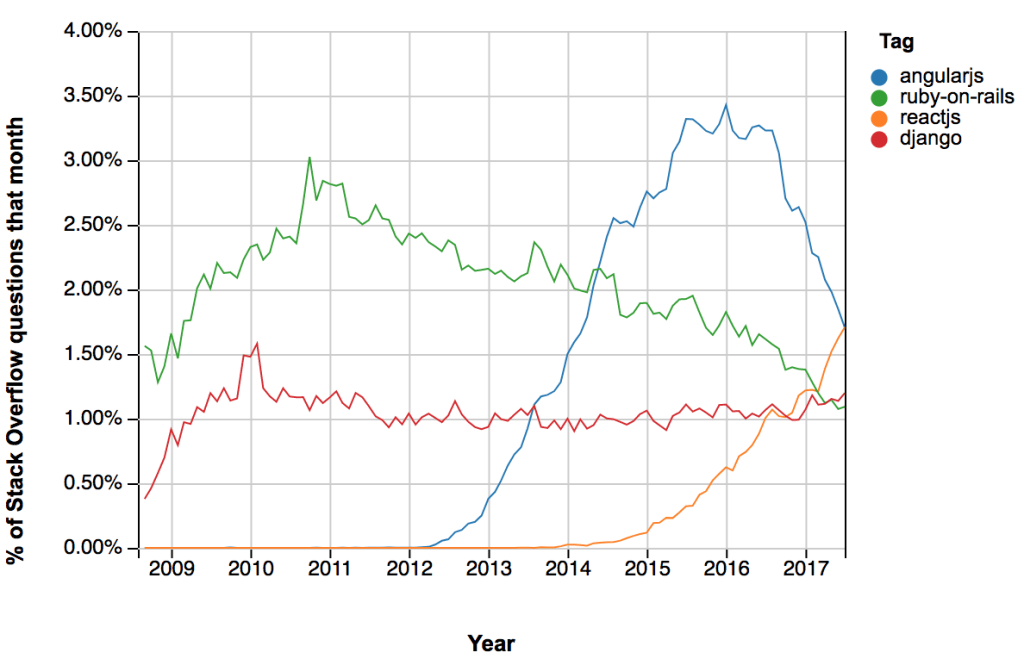
We can immediately see that Django has been a persistent technology since 2010 that has won the confidence of developers. We also note an increase in discussions about this framework from 2014 to today. The observed trend should continue. JavaScript frameworks literally exploded in 2013. They should remain at high levels provided that new uses do not upset everything. Finally Ruby on Rails experienced a very important hour of glory but saw since 2011 a progressive decline.
Credit: Ambiguous Solutions.
 99WebDevelopment Services